A small bathroom doesn’t have to feel cramped or limit your design options. With smart layout choices, space-saving fixtures, and durable materials, you can create a bathroom that feels more open, functional, and comfortable without adding square footage. For homeowners in Caldwell and throughout the Treasure Valley, this guide explores practical small bathroom remodeling ideas, popular upgrades, budgeting considerations, and what to expect during construction. Rich Fletcher, co-owner of Good Vibes Construction in Caldwell, shares insights to help you make the most of your space.
Key Takeaways
- Choose porcelain for a shower floor over natural stone if you would rather not reseal a surface that gets wet every day.
- Save bold color for paint and accessories, because a pattern set in tile can only be changed by tearing it out.
- Insist on a waterproof membrane behind shower tile, since grout and backer board on their own let water reach the framing.
How can layout, storage and light make a small bathroom feel bigger?
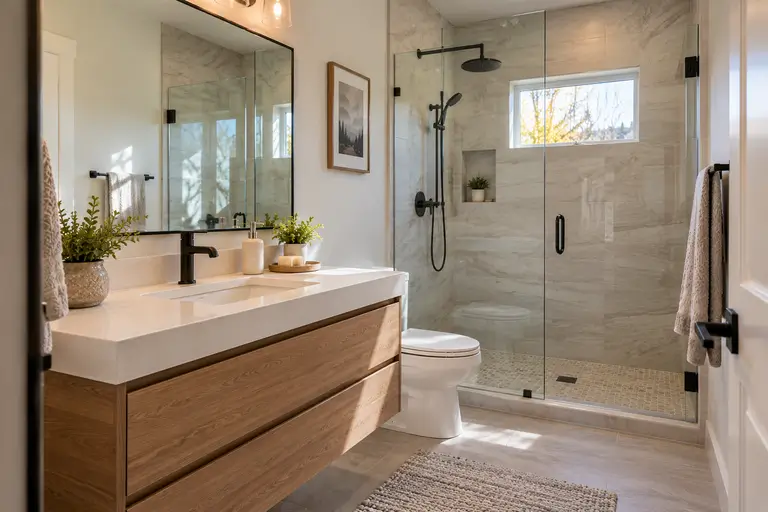
A small bathroom feels bigger when more floor shows, storage moves into the walls, and light reaches every corner. Anything lifted off the floor lets the eye read the full footprint. A pocket door frees the space a swinging door claims.
Some layouts only open up if a fixture moves. Shifting a toilet or shower drain means new plumbing in the floor and walls. Separately, the remodeling contractor you hire should be registered with the Idaho Contractors Board. A layout change is also where the budget grows, so know your options for financing a home remodel before you commit to one.
A wide mirror on the vanity wall bounces light back across the room. Clear glass in place of a curtain lets the shower read as part of the floor plan. Glass holds steam in, though, and the EPA’s remodeling guidance warns that even with good ventilation, moisture-laden air can still work into wall and ceiling cavities. Plan the exhaust fan with the glass.
Which shower, tub and vanity upgrades suit a primary bath?
Match the upgrade to how you use the room: trade a tub nobody soaks in for a bigger shower, and add a second sink only if two people share mornings.
| Upgrade | Suits | What to weigh |
|---|---|---|
| Walk-in shower replacing the tub | You shower daily and rarely bathe | Curbless entry means recessing the subfloor |
| Freestanding tub | Floor space to walk around it | Framing under a filled tub |
| Double vanity | Two people on the same morning schedule | Counter space left beside each sink |
Which tile, fixtures and finishes hold up to daily use?
Porcelain tile, epoxy grout and fixtures with solid metal bodies hold up to a bathroom used every day. Porcelain is dense and takes water without staining, so it suits a shower floor where natural stone would need resealing. On the floor, choose a matte or textured surface, since polished tile turns slick when wet. Epoxy grout resists stains and mildew better than cement grout, though it takes a practiced hand to set. For faucets and shower valves, look for brass bodies and ceramic disc cartridges instead of plastic internals. Brushed finishes hide water spots between cleanings. Finish work is where co-owner Russ DeArment learned the trade, and in a small bath it shows at the edges, where tile meets the tub.
How do you turn your ideas into a remodel plan?
Turn ideas into a plan by writing down what your current bathroom gets wrong, then checking each idea against that list. Sort the ideas into must-haves and nice-to-haves. Mark any that move the toilet or a drain, since plumbing changes set the scope of the job. Measure the room, then photograph what you want changed. That packet gives a contractor something concrete to work from on the first visit. The towns we serve are listed on our page about remodeling services across the Treasure Valley.
Which bathroom trends last, and which ones date fast?
Plain choices in the parts that are hardest to undo tend to last. Bold color or pattern locked into tile dates fast, because changing it means demolition. Anything set in mortar, such as wall tile or a shower pan, has to suit the room for as long as you own it. Put the current look where a weekend can change it, on painted walls or in cabinet hardware. If a patterned tile tempts you, keep it to one feature wall or a small stretch of floor.
What drives the cost of a small bathroom remodel?
The price of a small bathroom remodel is set by how much of the room comes out, what turns up behind the walls once it does, and the finishes you choose. Less floor means less tile to buy, but the plumber and tile setter still have to come, so labor does not shrink with the room. Hidden damage is the swing factor: a soft subfloor at the toilet or rotted framing behind an old tub surround has to be fixed before anything new goes over it. Tile layout adds hours too. Small mosaics or a herringbone pattern take more cuts than large plain tile.
Fixture choice keeps costing or saving after the job ends. The EPA’s WaterSense program says a whole or partial bathroom remodel with WaterSense fixtures can save nearly 10,000 gallons of water every year, plus energy and money.
Our Treasure Valley bathroom remodel cost guide puts local numbers to these factors, and a completed bathroom remodel shows what a full-scope job takes in. We handle bathroom remodeling across the Treasure Valley, Caldwell bathroom remodeling included.
What bathroom renovation mistakes should you avoid?
Watch for the mistakes that get buried in the walls, since fixing them later means tearing out finished tile.
- Trusting tile to keep water out. Grout and cement backer board both let moisture through. A waterproofing membrane behind the tile is what protects the framing.
- Roughing in the valve before choosing the trim. Trim fits only its own maker’s valve body, so pick the trim first or you are stuck matching whatever valve is already in the wall.
- Closing walls without blocking. Grab bars, a glass door or a heavy shelf need solid wood behind the drywall, added while the studs are open.
- Letting demolition dust travel. Dust spreads through the house unless the room is sealed off. The EPA’s guidance on remodeling and indoor air quality covers managing dust and ventilation during a bathroom renovation.
How much does a refresh, wet-area redo or full gut disrupt your home?
A refresh barely disturbs the house, a wet-area redo takes one zone of the bathroom out of service, and a full gut leaves you without the room until the last fixture is set. How much you lose depends on how deep the work goes.
| Scope | What comes out | What it disturbs |
|---|---|---|
| Refresh | Vanity, faucet, toilet, mirror, paint | Water shuts off during each swap; the room stays usable most days |
| Wet-area redo | Shower or tub surround, down to the studs | No shower until waterproofing and tile are finished; the toilet and sink can stay in use |
| Full gut | Everything, to the studs and subfloor | The room is out of use for the whole job |
A refresh is the least disruptive way to put in water-saving fixtures. The EPA’s WaterSense program says that if one in every 10 American homes upgraded a full bathroom with WaterSense labeled fixtures, the country could save about 93 billion gallons of water and about $1.3 billion on utility bills per year.
To talk through which scope fits your bathroom, call Good Vibes Construction at (208) 995-5505 or send us a message.
Sources
- Contractors Board – Division of Occupational and Professional Licenses, Idaho Division of Occupational and Professional Licenses, Contractors Board, retrieved 2026-10-05.
- Your Better Bathroom | US EPA, epa.gov, retrieved 2026-10-05.
- Remodeling Your Home and Indoor Air Quality | US EPA, epa.gov, retrieved 2026-10-05.