Common Deck Building Mistakes Treasure Valley Homeowners Should Avoid
The most common deck building mistakes are poor planning, skipping the permit, weak footings, ledgers and framing, loose guardrails and uneven stairs, choosing decking that cannot handle Idaho’s hot summers and freeze-thaw winters, and leaving out drainage and flashing. Most of them start on paper, long before a board is cut. The cheapest place to catch them is in the plan or the bid you are reviewing.
Key Takeaways
- The ledger connection to the house is a known failure point and needs proper fasteners and flashing.
- Decking for Caldwell should be chosen for summer sun and freeze-thaw cycles, not for looks alone.
- A good bid spells out footings, framing, flashing, materials and permits, so nothing is left to guesswork.
What planning mistakes happen with deck size, placement and everyday use?
The biggest planning mistake is designing around a photo instead of how you live. A deck too small for your table, baked by afternoon sun, or blocking a window becomes a space you avoid.
Treasure Valley summers are dry and the high-desert sun is strong, so a west- or south-facing deck in Caldwell can stay too hot to use until evening. Put shade, a pergola or a covered section into the first drawing rather than bolting it on later. Check the sprinklers too: many local yards run on pressurized irrigation, and heads that spray the deck boards or posts every day keep the wood wet through the hottest months.
Picture the real traffic: kitchen door to grill, chairs pulling back, where stairs land. Browsing deck design ideas for Treasure Valley homes helps settle size and shape before custom deck builders start drawing your outdoor living spaces.
What goes wrong when you skip the permit and inspections?
Without a permit, no inspector sees your footings, ledger or framing before they are covered.
Skipping it is one of the most common shortcuts, and it removes the only outside check on the structure. Idaho adopts the International Residential Code with local amendments, and its deck section, R507, covers footings, ledgers, joists, beams and guards. An unpermitted deck can complicate a sale or need opening up for inspection later.
Who handles deck permits in Caldwell and Canyon County?
Inside Caldwell city limits, the City of Caldwell building department reviews deck plans. Outside the city, Canyon County Development Services handles them, and Boise runs its own permit office. Expect to submit a site plan showing setbacks from property lines, along with footing and framing details. Inspections typically come at the footing holes before concrete is poured, at framing before decking goes down, and at final. Our guide to deck permits in Boise covers what local offices ask for.
Which footing, ledger and framing mistakes cause decks to fail?
The ledger board, where the deck meets the house, is the classic failure point, but posts, guards and stairs are where a weak deck usually shows itself first.
Is the ledger attached to the house correctly?
The ICC’s guidance on deck-to-house connections explains that a poor ledger connection is a key cause of collapses. Warning signs: nails instead of proper fasteners, or a ledger fixed to siding rather than the rim joist. Undersized beams and over-spanned joists bounce and sag, and hardware not rated for treated lumber can corrode out of sight.
Are the footings below frost depth?
Footings that stop above the frost line get pushed up as wet soil freezes and thaws, racking the frame a little more each winter. Caldwell, Canyon County and Boise each set the required frost depth through their local code amendments, so ask the building department for the figure and confirm the bid matches it.
Footings should also bear on undisturbed soil, not loose backfill from the foundation dig.
Are the posts, guardrails and stairs built to code?
Inspectors look closely here, and so should you. Common errors include:
- Posts notched deeply or toe-screwed to the rim instead of through-bolted or set in tested connectors
- Guard posts that flex when you lean on them because the blocking behind them was left out
- Balusters spaced too wide for the opening limit in the International Residential Code, leaving room for a small child to slip through
- Stair risers of uneven height, which trip people even when the difference looks small
- No graspable handrail, stringers resting on bare soil, or a bottom landing with no solid pad
Ask the builder to show how guard posts are fastened and how stair stringers are supported at the top and bottom.
Why does decking material need to suit Idaho sun and freeze-thaw?
Treasure Valley decking faces hot, dry summers and repeated freeze-thaw winters. Low humidity and strong high-desert sun dry wood quickly, so unsealed boards check and split. Composite and PVC boards expand in heat, and skipping the manufacturer’s gap spacing leads to buckling.
For composite and plastic lumber, ask whether the boards carry ratings under ASTM D7032, the standard for composite deck boards. Darker boards hold more heat underfoot on a July afternoon.
Our comparison of composite, wood and PVC decking for Idaho covers the trade-offs.
Which drainage, flashing and finishing details get skipped?
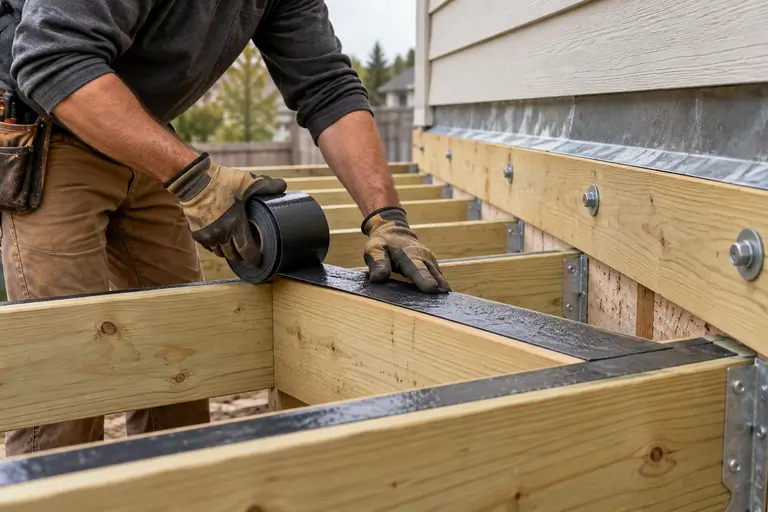
The skipped details are the ones hidden once the deck is finished. Water trapped against the house or framing rots wood quietly for years. Check for:
- Flashing over the ledger, lapped behind the siding
- Joist tape on the tops of joists and beams
- Consistent gaps between boards so water drains through
- A slight slope away from the house
- Enough clearance underneath for airflow and drying
- Cut ends of treated lumber sealed before installation
What budget mistakes happen, and what drives what a deck costs?
What budget mistakes do homeowners make?
The common one is pricing only the decking boards and forgetting the structure, railings and stairs around them. A low number that leaves out footings, flashing or the permit tends to grow once work starts.
What drives what a deck costs?
- Size, height and the number of levels
- Shape: curves and radius edges take more labor
- Decking material and railing system
- Stairs, landings and lighting
- Removing an old deck and preparing the site
Our breakdown of deck costs has the pricing detail.
How do you check a deck builder’s plan before you sign?
A sound plan answers every structural question in writing before work starts. If the bid is vague on footings, ledger attachment or flashing, ask until it is not.
| Mistake | Why it happens | What to look for in the plan or bid |
|---|---|---|
| Weak ledger | Attached to siding or with nails | Fastener type and rim joist attachment named |
| Shallow footings | Frost depth ignored | Footing depth tied to local frost depth |
| Loose guards or uneven stairs | Posts notched or toe-screwed, risers cut by eye | Guard post connection and stair layout detailed |
| Missing flashing | Hidden once built | Ledger flashing and joist tape listed |
| No permit | Saving time upfront | Permit and inspections included |
| Wrong material | Chosen on looks alone | Board type, ratings and gap spacing stated |
- Confirm who pulls the permit and which office issues it.
- Ask how the ledger is fastened and flashed.
- Check that footing size and depth are specified.
- Get the material, railing and stair details named.
Russ DeArment leads design and construction, and Rich Fletcher walks homeowners through materials, budgets and timelines from day one. Good Vibes Construction holds RCE 69010. When you are ready, see how we handle custom deck construction, or talk with our deck builders in Caldwell.
Get in touch to plan your project.
Frequently Asked Questions
What is the 3/4/5 rule for decks?
A layout method for squaring corners: measure three units along one side and four along the other. When the diagonal reads five, the corner is square.
What is the average lifespan of a deck?
A deck usually wears out at its structure before its surface. Footings below frost depth, a bolted and flashed ledger, rated hardware and taped joists let the frame outlast more than one set of boards, while a nailed ledger or shallow footings can end a deck early whatever it is surfaced with. Composite and PVC need less upkeep through Idaho’s sun and freeze-thaw winters; wood needs regular resealing to hold off checking and rot.
What is the most expensive part of a deck?
On most decks, the decking boards and railing system are the largest line items, especially in composite, PVC or metal. Framing and footings come next. Stairs, curves and extra levels add labor on top.
Sources
- Is your deck safely connected to your house? – ICC – International Code Council, retrieved 2026-10-01
- The International Residential Code – ICC – International Code Council, retrieved 2026-10-01
- D7032 Standard Specification for Wood-Plastic Composite and Plastic Lumber Deck Boards – ASTM International, retrieved 2026-10-01